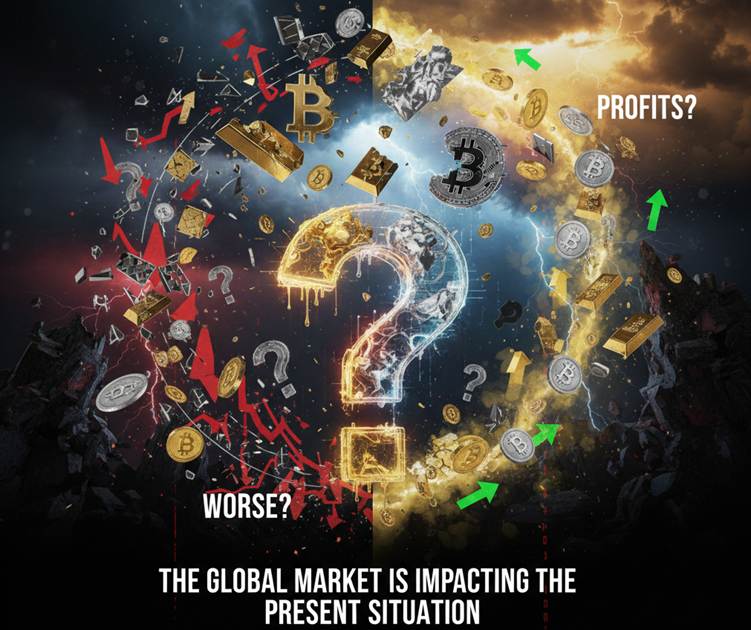
Global financial markets have entered a phase where traditional assumptions are being tested. Gold, silver and bitcoin — assets often associated with protection during uncertainty — have all faced pressure as currency strength, shifting risk appetite and heightened volatility reshape investor behaviour.
While periods of bargain buying have provided temporary relief, the broader environment remains fragile. Market participants are navigating a landscape where liquidity matters more than labels, and correlations are tightening across asset classes.
Precious Metals Struggle to Regain Stability
Gold and silver have shown brief signs of recovery during periods of calmer trading, supported by selective buying after sharp and unpredictable moves. However, both metals continue to operate under pressure as a strong reserve currency and softer equity sentiment influence global capital flows.
Gold has displayed relative resilience, supported by its long-standing role as a store of value. Silver, by contrast, has remained more vulnerable. Its sensitivity to economic expectations and industrial demand has amplified price swings, making it less stable during risk-off phases.
Periods of market stress have encouraged investors to reduce exposure across portfolios, leading to selling even in assets traditionally considered defensive. This behaviour highlights a recurring theme in volatile environments: when uncertainty rises sharply, liquidity often takes priority over conviction.
Bitcoin Faces an Identity Test
Bitcoin has also struggled during bouts of global market weakness, challenging its reputation as an alternative safe haven. Rather than moving independently, the digital asset has increasingly tracked broader risk sentiment, declining alongside equities during periods of stress.
This behaviour has raised questions about bitcoin’s role within diversified portfolios. While often promoted as a hedge against monetary instability, its recent performance suggests it behaves more like a speculative asset when volatility spikes.
Investor confidence has been tested as adoption narratives clash with real-world market behaviour. In uncertain conditions, bitcoin has shown a tendency to amplify portfolio swings rather than cushion them.
When Everything Falls Together, There Are No True Safe Havens
For years, investors relied on a familiar framework: gold preserves wealth, silver reflects growth expectations, and bitcoin represents a digital alternative to traditional stores of value. Recent market action has disrupted that framework.
The defining force behind these moves has not been supply or long-term fundamentals, but psychology. As currency strength intensified and equity markets weakened, investors did not rotate smoothly into defensive positions. Instead, many reduced exposure across the board, favouring flexibility and access to cash.
This pattern reinforces a critical insight for modern markets: diversification only works when assets respond differently to stress. When correlations rise, even carefully balanced portfolios can experience simultaneous drawdowns.
What This Means for Investors
Periods of broad-based selling are uncomfortable, but they are not unusual. Understanding the dynamics behind them can help investors respond with clarity rather than emotion.
Key takeaways:
- Market volatility can pressure all asset classes at once
- Traditional safe-haven behaviour may weaken during liquidity-driven sell-offs
- Digital assets often remain closely linked to broader risk sentiment
- Short-term price action does not always reflect long-term value
Rather than reacting to daily fluctuations, investors may benefit from focusing on structure, discipline and time horizon. Gradual positioning, portfolio balance and risk awareness remain essential tools in uncertain environments.
The Bigger Picture for 2026
As markets continue to adapt to shifting monetary conditions, geopolitical developments and evolving investor expectations, gold, silver and bitcoin will remain under scrutiny.
The central lesson is not that these assets have failed, but that their behaviour is shaped by context. In a world defined by rapid information flow and interconnected markets, no asset operates in isolation.
For investors navigating the year ahead, understanding why assets move — not just how much they move — will be far more valuable than chasing certainty in an uncertain world.
About the Author